What Music Education is Provided at Nandini Sangeet Kala Kendra?
Nandini Sangeet Kala Kendra provides structured, practice-oriented training in North Indian classical and traditional music. Our offerings cover 1) Indian Vocal Music / Gayan (Swara Sadhana, voice stabilization, Alankars, foundational Ragas, and devotional singing); 2) Tabla (finger stroke clarity, bols, Teental, Dadra, Keharwa, solo rhythm development, and accompaniment); 3) Harmonium (keyboard fingering, bellows control, supporting vocal scales); and 4) Dholak & Indian Instruments (folk beats, bhajan accompaniment, and stage timing). Batches accommodate children, beginners, and adult hobby learners.
Indian Classical Vocal Music (Gayan)
Vocal music is considered the fountainhead of all Indian musical arts. In classical tradition, every instrument seeks to emulate the expressiveness, continuity, and nuanced micro-tonal inflections of the human voice.
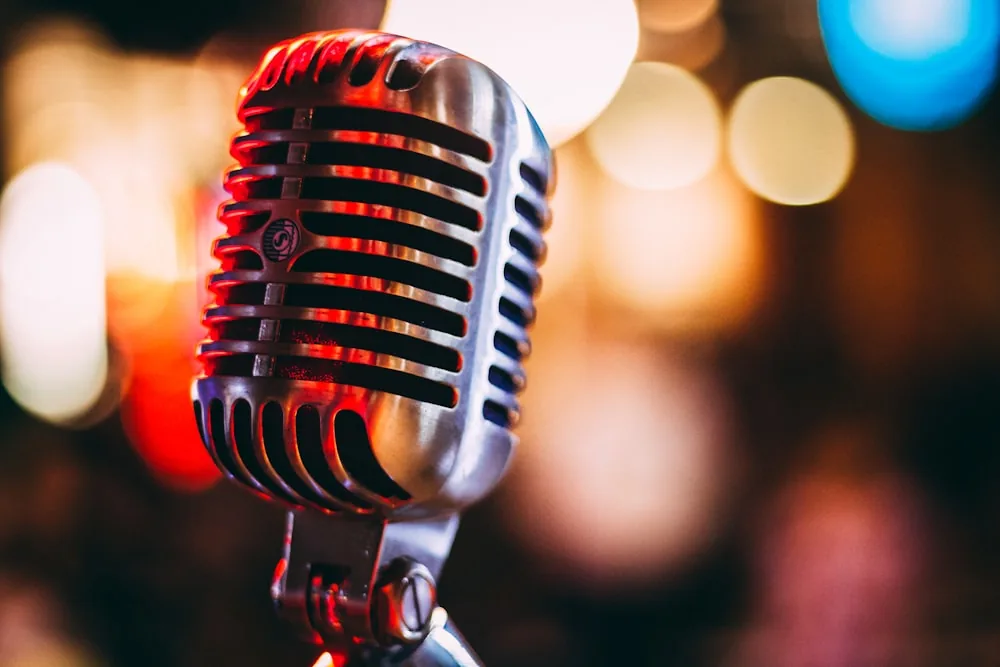
1. Swara Sadhana & Voice Culture
At Nandini Sangeet Kala Kendra, vocal training begins with Swara Sadhana—the deep, meditative alignment of the singer's voice with the fundamental drone of the Tanpura. Students learn to cultivate unwavering stability on the tonic note (Sa), expanding lung capacity and diaphragmatic breath control across the three octaves:
- Mandra Saptak (Lower Octave): Developing chest resonance, vocal warmth, and grounded low-frequency tonal stability.
- Madhya Saptak (Middle Octave): Establishing natural conversational pitch, effortless stamina, and pure open-throat vowel enunciation.
- Taar Saptak (Upper Octave): Accessing higher frequencies through relaxed head resonance without artificial constriction or throat fatigue.
2. Alankars, Palte & Scalar Agility
Alankars (musical ornaments) and Palte are structured mathematical permutations of notes designed to build agility, vocal flexibility, and rapid pitch recognition:
- Shuddha Swara Permutations: Progressing from stepwise note sequences (Sa Re Ga Ma) to skips, leaps, and reverse scalar patterns (Sa Ga Re Ma).
- Komal & Teevra Interval Precision: Training the ear to distinguish subtle flat (Komal Re, Ga, Dha, Ni) and sharp (Teevra Ma) intervals with acoustic accuracy.
- Laya Variations: Singing permutations across Vilambit (slow), Madhya (medium), and Drut (fast) tempos to develop tongue agility and breath control.
- Swara Gyaan & Ear Training: Rapid auditory identification and immediate vocal reproduction of melodic phrases demonstrated by the teacher.
3. Raga Foundations & Bandish Compositions
Students progressively explore North India's introductory Ragas, understanding the architectural grammar and emotional personality (Rasa) that defines each melodic form:
- Core Introductory Ragas: Systematic study of foundational ragas including Yaman (Kalyan Thaat), Bilawal, Bhairav, Kafi, and Bhupali.
- Aroha, Avaroha & Pakad: Grasping the ascending scale, descending scale, and characteristic identifying phrase that reveals a raga's soul.
- Bandish & Compositions: Learning traditional lyrical compositions set to structured rhythmic cycles (such as Teental, Ektaal, and Roopak).
- Alaap & Taan Basics: Unfurling notes through meditative slow Alaap, accelerating through structured rhythmic Taans while keeping strict time.
4. The Spirit of Daily Riwaz & Devotional Gayan
Vocal excellence requires patient nurturing. We guide learners in creating effective home practice habits and applying classical vocal purity to devotional music:
- The Discipline of Morning Riwaz: Demonstrating how 20 to 30 minutes of focused morning Swara Sadhana transforms vocal tone, confidence, and musical awareness.
- Acoustic Voice Projection: Training the vocal cords for resonant clarity in acoustic environments without dependency on artificial sound systems.
- Bhajan & Semi-Classical Gayan: Applying classical vocal principles to expressive semi-classical bhajans, kirtans, and regional Kumaoni devotional poetry.
- Concert & Recital Poise: Demystifying performance anxiety through regular studio recitals, teacher feedback, and live acoustic accompaniment.
Tabla Classes: Taal, Bols & Accompaniment
The Tabla is the premier percussion instrument of Indian classical music, renowned worldwide for its nuanced tonal palette, acoustic mechanics, and dazzling rhythmic mathematics.
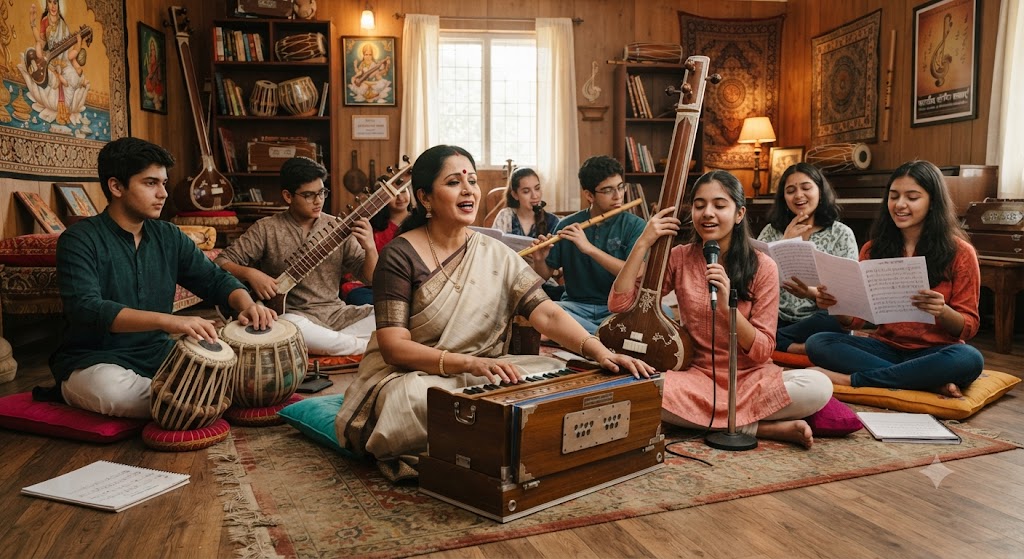
Anatomy of the Twin Drums
The Tabla is an acoustically paired percussion system uniting two contrasting physical bodies:
Pure Stroke Technique & The Bols System
Every stroke on the Tabla produces a distinct phonetic syllable (Bol). Students master wrist flexibility, finger separation, and acoustic weight distribution:
Sharp, bell-like treble strike executed with the index finger against the skin perimeter while resting the ring finger lightly on the syahi edge.
Pure, ringing open tone played on the inner field without muting, allowing natural acoustic vibration and harmonic resonance to breathe.
Sliding the base of the wrist across the bass head while depressing the skin to create the iconic expressive Indian pitch-bend glissando.
Harmonized simultaneous strikes of Dayaan and Bayaan (Na + Ge = Dha; Tin + Ge = Dhin), establishing the rhythmic bedrock of all North Indian music.
Teental (16 Beats)
The king of classical rhythm: divided into four Vibhaags (4+4+4+4) with three Talis and one Khali. Students master Kaydas, Palte, Relas, and Tihais.
Dadra & Keharwa
6-beat Dadra and 8-beat Keharwa: dynamic rhythmic cycles powering semi-classical vocal, bhajans, ghazals, and regional Kumaoni celebratory folk tunes.
Roopak & Jhaptal
Asymmetrical meters: 7-beat Roopak (Khali on beat 1) and 10-beat Jhaptal (2+3+2+3), developing advanced Layakari and mental counting under pressure.
Live Accompaniment
The art of Sangat: listening, anticipating breath, maintaining steady tempo (Theka), and providing sensitive dynamic rhythm to singers and dancers.
Mastering Indian Instruments: Harmonium & Dholak
Essential instruments for accompanying Indian classical music, community devotional gatherings, and regional Himalayan festivities. At Nandini Sangeet Kala Kendra, instrumental training bridges precise classical keyboard pitch alignment with energetic Northern Indian folk percussion.
Harmonium Bellows & Sur
Developing continuous, smooth left-hand air pumping and right-hand scalar agility across Thaats, foundational Ragas, and vocal accompaniment.
Dholak Dual-Head Percussion
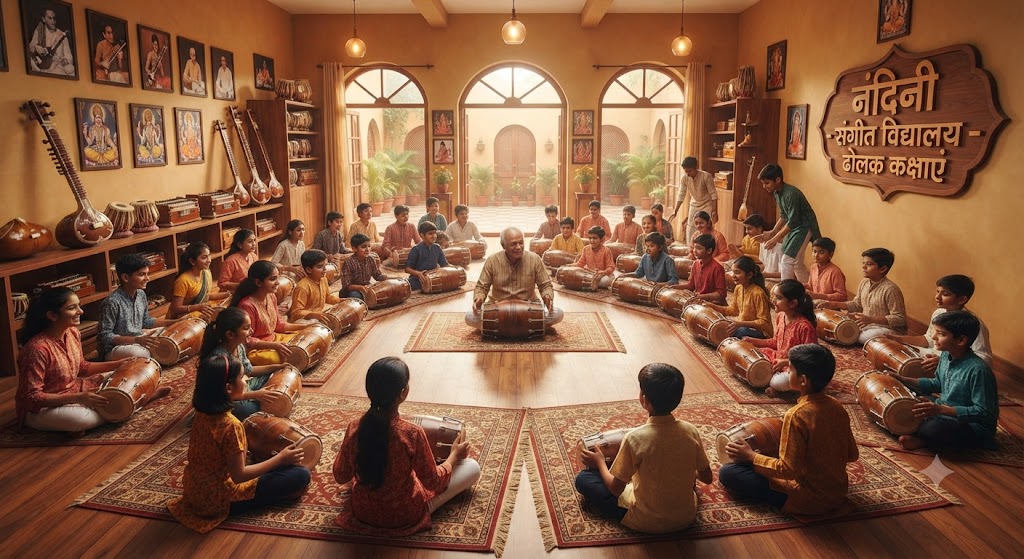
Mastering sharp treble slaps and resonant bass modulations for celebratory Keharwa, Dadra, and authentic Kumaoni folk songs.
Live Accompaniment Skills
Training the ear to track vocal contour in real-time, providing sensitive harmonic support and tempo stability during live recitals.
Satsang & Festive Performance
Preparing learners for community Bhajans, temple gatherings, family celebrations, and Himalayan cultural festivals in Kumaun.
Instruction is tailored to student goals: classical vocalists learn keyboard accompaniment to support their own daily Riwaz, while hobbyists and percussionists develop celebratory rhythm skills with enduring cultural joy.
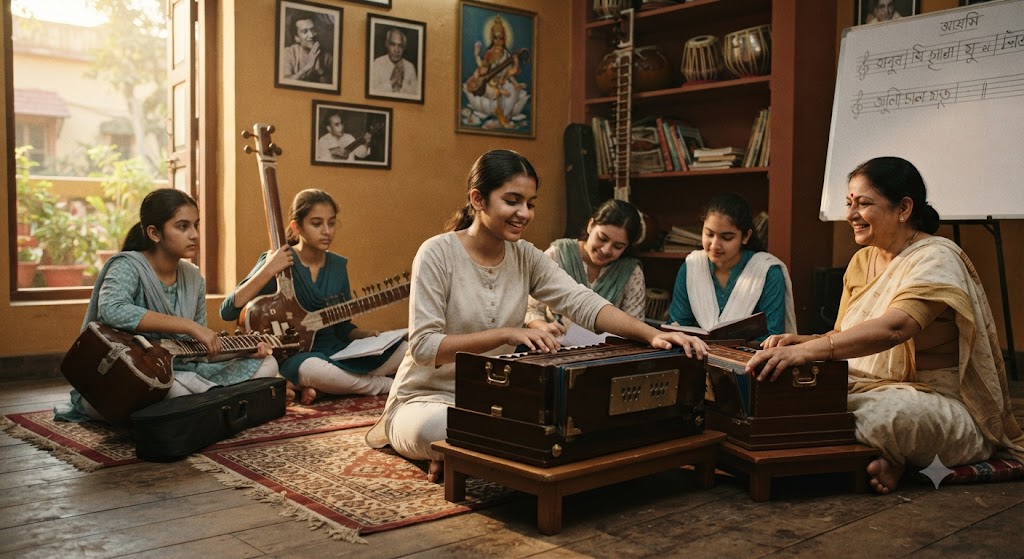
Music Education Syllabus & Structure
Structured modules designed to take students from foundational sound recognition to confident acoustic performance.
| Discipline | Beginner Stage | Intermediate Stage | Performance & Accompaniment Stage |
|---|---|---|---|
| Indian Vocal (Gayan) | Sa Sadhana, Tanpura alignment, 10 basic Alankars, voice breath control | Introductory Ragas (Yaman, Bhupali, Bilawal), Chota Khayal bandish, Teental | Vilambit Khayal, Alaap, Taans, Bhajan presentation, concert stage readiness |
| Tabla | Basic hand placement, striking Na, Tin, Dha, Dhin, Teental Theka | Kaydas with Palte and Tihai in Teental, Keharwa, Dadra variations | Relas, Tukras, Jhaptal, Roopak, vocal/dance live accompaniment skills |
| Harmonium | Bellows control, natural keyboard fingering, 10 basic Thaats | Playing simple Raga melodies, accompanying Alankars, basic Bhajans | Advanced finger agility, spontaneous vocal accompaniment, devotional leading |
| Dholak | Bass-treble balance, fundamental Keharwa and Dadra folk beats | Syncopated pick-ups (Uthan, Mohra), festive tempo variations | Live bhajan and folk song accompaniment, group percussion harmony |
Looking for Recognized Degrees in Music & Dance?
Nandini Sangeet Kala Kendra is affiliated with Prayag Sangeet Samiti, Allahabad. Prepare for Junior Diploma, Senior Diploma, Sangeet Prabhakar (B.A. equivalent), and Sangeet Praveen (M.A. equivalent) with official annual examinations in Kathgodam–Haldwani.
Music Learning for Children, Beginners & Adults
Whether pursuing classical rigor or artistic joy, our doors are open to dedicated learners across Haldwani and Kathgodam.
Children & Early Learners
Learning music at an early age sharpens listening comprehension, enhances mathematical thinking through rhythm, and instills peaceful concentration.
Adult Beginners & Hobbyists
Many working professionals and homemakers find music to be a therapeutic, deeply rejuvenating pursuit. We offer evening batches with patient, encouraging instruction.
Cultural & Devotional Performers
For individuals who wish to sing at local temple gatherings, community satsangs, or family functions, we provide practical training in bhajan singing, harmonium accompaniment, and dholak rhythm.
Frequently Asked Questions About Music Classes
Common questions answered regarding vocal and instrumental learning at Nandini Sangeet Kala Kendra.
Instruments are available at the academy for classroom instruction. However, because daily riwaz (practice) is essential for muscle memory and progress, our instructors will guide you on selecting an appropriate student-grade Tabla, Harmonium, or Dholak for home practice after your initial sessions.
Yes. Everyone possesses a natural voice. Classical Swara Sadhana systematically trains the ear and the vocal muscles to recognize pitch and sing on key, starting with simple fundamental notes.
The Tabla is primarily an intricate classical instrument featuring strict mathematical grammar, bols, and solo classical compositions. The Dholak is a versatile barrel drum used extensively in folk music, devotional bhajans, and community singing where rhythmic drive and festive accompaniment are paramount.
Classes are conducted in small, focused batches so that each student receives individual attention to finger placement, pitch correction, and breathing while benefiting from peer listening.
Music classes take place at Nandini Sangeet Kala Kendra, located at C/o Harish Joshi, Aadarsh Colony, opposite Railway Station Road, behind Roadways Workshop, Kathgodam–Haldwani, Nainital, Uttarakhand.
Immerse Yourself in the Magic of Sur & Taal
Enrol in our Indian Vocal (Gayan), Tabla, Harmonium, or Dholak batches today. Connect via WhatsApp or submit your admission enquiry to get started.