Kathak Classical Dance Classes: Complete Gharana Training & Certification
Systematic instruction in authentic North Indian Kathak under Ms. Sonika Joshi (~20 years dance experience, Jaipur & Gwalior traditions). From foundational Tatkar and lightning Chakkars to expressive Abhinaya and Prayag Sangeet Samiti diploma pathways.
Kathak is one of the eight major forms of Indian classical dance, rooted in the ancient Sanskrit adage "Katha Kahe So Kathak Kahlawe" (the one who tells a story is a Kathak). Originating among travelling bards in ancient North India, it evolved into an intricate classical discipline characterized by rhythmic footwork (Tatkar), rapid spins (Chakkars), precise hand gestures (Hasta Mudras), and poetic emotional storytelling (Abhinaya).
At Nandini Sangeet Kala Kendra in Kathgodam–Haldwani, Kathak is taught with rigorous anatomical alignment, classical Taal discipline (Teental, Jhaptal), and structured examination syllabi accredited by Prayag Sangeet Samiti, Allahabad.
Kathak Fast Facts & Academic Blueprint
| Discipline | Kathak Classical Dance (North Indian Classical Tradition) |
|---|---|
| Gharana Lineages | Jaipur Gharana (rhythmic precision, fast Tatkar, Chakkars) & Gwalior Traditions |
| Lead Faculty | Ms. Sonika Joshi (~20 years dance experience) |
| Core Pillars | Tatkar (footwork), Chakkars (pirouettes), Hasta Mudras (hand gestures), Abhinaya (expression) |
| Affiliated Examination | Prayag Sangeet Samiti, Allahabad (Junior Diploma to Sangeet Prabhakar & Praveen) |
| Academy Location | Aadarsh Colony, Opp. Railway Station Road, Kathgodam–Haldwani, Nainital, Uttarakhand |
| Batch Eligibility | Beginners (from age 5+), Teenagers, Adults, and Advanced Practitioners |
The Four Structural Pillars of Kathak Dance
Traditional Kathak balances technical virtuosity (Nritta), expressive storytelling (Nritya), and dramatic characterisation (Natya). Every student trains through four interdependent disciplines:
Tatkar & Footwork Precision
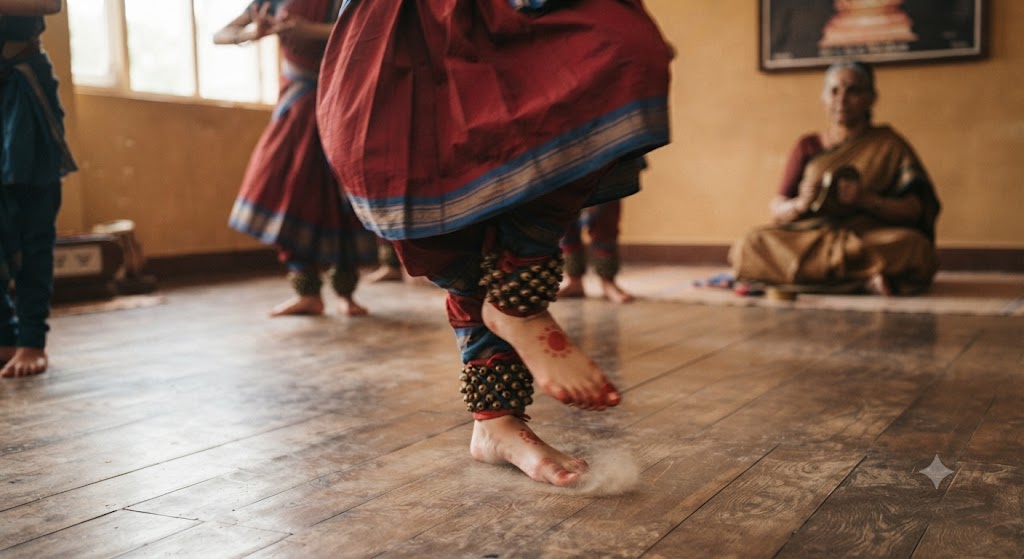
Tatkar forms the foundational footwork of Kathak, executed by striking the flat of the foot and the heel in precise coordination with rhythm. Beginners master the fundamental syllables Ta - Thei - Thei - Tat / Aa - Thei - Thei - Tat in Teental (16-beat cycle).
As the student matures, bells (Ghungroos) ranging from 50 to 100 on each ankle produce crisp, acoustic rhythmic accents. Training progresses across tempo gradations: Vilambit Laya (slow tempo for stability), Madhya Laya (medium tempo), and Drut Laya (high speed for virtuosic control), incorporating Layakari variations including Dugun (double), Chaugun (quadruple), and Athgun (eight-fold speed).
Chakkars & Pirouette Dynamics
The Chakkar (swift pirouette on the heel or ball of the foot) is a hallmark of Kathak, celebrated for its geometric grace and breathtaking momentum. Students learn the classical five-count and one-count turns while maintaining upright spine posture and focused eye spotting (Drishti Bhed).
In the Jaipur tradition, dancers execute multiple sequential Chakkars (up to 27 or 54 continuous rotations) resolving with pin-point precision on Sama—the pivotal first beat of the rhythmic cycle.
Hasta Mudras & Facial Expression
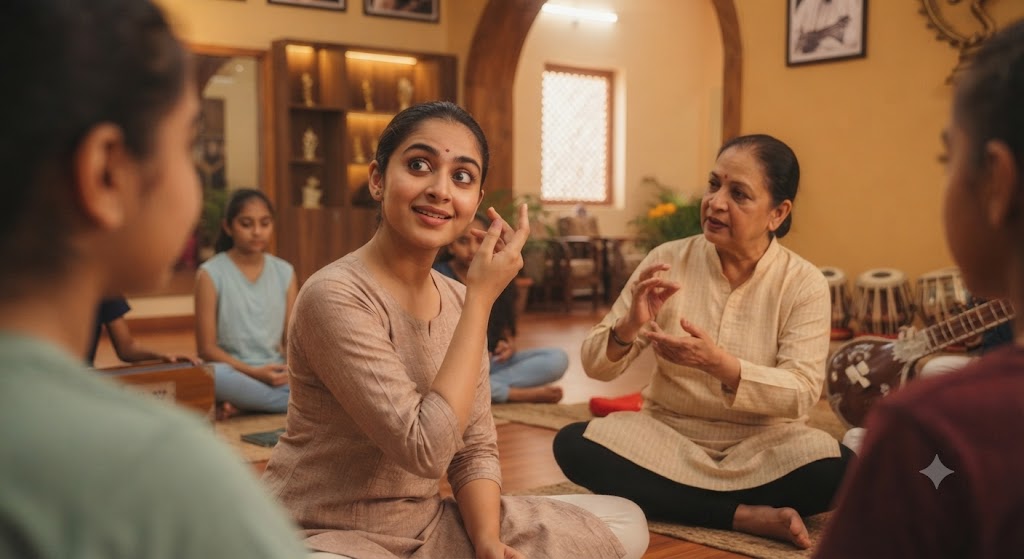
According to the classical text Abhinaya Darpana, hand gestures are categorized into Asamyuta Hasta (single-hand gestures such as Pataka, Tripataka, Mayura, and Ardhachandra) and Samyuta Hasta (combined two-hand gestures such as Anjali, Kapota, and Karkata).
Through subtle eye, brow, and neck movements (Greeva Bhed), students depict the Navarasas (nine emotional essences: Shringara, Hasya, Karuna, Raudra, Veera, Bhayanaka, Bibhatsa, Adbhuta, and Shanta) to interpret classical Thumris, Bhajans, and Padas.
Bols, Padhant & Rhythmic Recitation
A true Kathak dancer is both a percussive musician and a visual storyteller. Before dancing any composition, students learn Padhant—the art of rhythmic recitation, keeping time on their hands with claps (Taali) and waves (Khaali).
Syllables of compositions—such as Amad (ceremonial entrance), Toda, Tukda, Paran (drum-syllable choreography), and Tihai (a phrase repeated three times ending on Sama)—are recited clearly with melodic resonance before being interpreted through foot and hand kinetics.
The Jaipur and Gwalior Gharana Influences
Lineage in Indian classical art preserves pedagogical purity while cultivating individual artistic nuance. Ms. Sonika Joshi brings around 20 years of practice informed by the dual influences of the Jaipur and Gwalior traditions.
The Jaipur Gharana Legacy
Emerging in the courts of Rajasthan, the Jaipur Gharana is world-renowned for its athletic vitality, complex rhythmic subdivisions, and virtuosity in Pakhawaj-derived compositions. Dancers from this tradition specialize in intricate Kavitts (poetic verses spoken and danced simultaneously), lightning-fast Chakkars, and formidable stamina in sustained Tatkar.
Gwalior & Central Indian Influences
The Gwalior musical tradition is historically one of the oldest pillars of North Indian classical art. When synthesized with Kathak pedagogy, it introduces deep vocal musicality, adherence to pure raga structure, and stately grace. Students at Nandini Sangeet Kala Kendra benefit from this balanced confluence of technical power and expressive refinement.
Prayag Sangeet Samiti Kathak Diploma Scheme
Nandini Sangeet Kala Kendra serves as a dedicated training and examination guidance centre for Prayag Sangeet Samiti, Allahabad (Prayagraj). Students can earn recognized diplomas following this systematic multi-year syllabus:
Junior Diploma (Years 1 & 2)
Foundational Level
Introduction to Teental (16 beats). Basic Tatkar in Thah, Dugun, Chaugun. Primary Hasta Mudras (Asamyuta). Simple Toda, Tukda, and Tihai. Padhant of basic bols and stage entrance.
Senior Diploma (Years 3 & 4)
Intermediate Mastery
Introduction to Jhaptal (10 beats) and Ektaal (12 beats). Intricate Chakkars and Chhand. Performance of Amad, Salami, and Paran. Beginner Abhinaya on devotional Padas and Vandana.
Sangeet Prabhakar (Years 5 & 6)
Graduate Equivalent Qualification
Advanced Taal mastery (Dhamar, Roopak). Complex Layakari (Tisra, Khand, Misra). Expressive Thumri and Gat Nikas. Comprehensive written theoretical papers in Natyashastra dramaturgy.
Documentary Citations & Authoritative References
Educational and cultural documentation on this page references verified regional, academic, and governmental repositories:
- Kathak Dance: Origin, Evolution and Gharanas — Sangeet Natak Akademi. National Academy for Music, Dance and Drama official archive
- Abhinaya Darpana & Natyashastra Texts — Indira Gandhi National Centre for the Arts (IGNCA). Classical Sanskrit dramaturgy manuscripts and English translations
- Sangeet Prabhakar Kathak Syllabus — Prayag Sangeet Samiti, Allahabad. Standardized annual examination scheme for North Indian classical dance
Frequently Asked Questions: Kathak in Haldwani
Children can begin foundational movement and rhythm training around age 5 or 6. At this age, classes emphasize rhythm play, clapping, basic footwork, and spatial coordination. Teenagers and adult beginners are equally welcome; adult batches focus on posture realignment, core strength, and systematic rhythmic training.
For daily riwaz, students wear comfortable, modest Indian attire such as a cotton kurta with churidar or leggings, allowing free knee movement and foot visibility. Dancing is conducted barefoot on clean studio floors. Ghungroos (ankle bells) are introduced once the instructor confirms foundational footwork control.
The academy is located at Aadarsh Colony, opposite Railway Station Road, behind the Roadways Workshop in Kathgodam–Haldwani. For batch timings and current admissions, call or WhatsApp 9411770122.
Experience the Elegance of Classical Kathak
Whether you seek formal diplomas through Prayag Sangeet Samiti, cultural enrichment, or stage confidence, join our disciplined Kathak studio in Kathgodam–Haldwani.